Showing posts with label Reno. Show all posts

Tuesday, September 15, 2009

Ambassador Pearce's Comments regarding the Youth Leadership Program for Algeria


The Youth Leadership Program (YLP) for 2009 started officially on July 12 2009 at the Embassy with the 25 selected students coming in to the consular section for their visa interviews, followed by a lunch buffet hosted by the Ambassador at his residence in Algiers. The morning also included an information session for the students and their parents, led by the Northern Nevada International Center, the official implementer of the program. The session provided time for the many questions prior to the travel of these “junior Ambassadors.” This year the program will commence with the 2 week English language/orientation in Setif, 4 hours southeast of Algiers, and then 4 weeks in Reno, Nevada.

Ambassador David D. Pearce's comments at the Luncheon on July 12 2009:

"Welcome to the U.S. Embassy and to the official opening of the Youth Leadership Program 2009. Congratulations to the 25 students and 3 Teachers and Chaperones selected to participate in this program. We commend you for your talents and skills that were demonstrated during the application and interview process. We are counting on each one of you to take full advantage of this opportunity to improve your English language skills and your leadership skills, and to learn firsthand about the United States and its people.

This is the 5th year of the Youth Leadership Program in Algeria. The USG commends the support that the Ministry of National Education has provided in the past, and we look forward to a relationship of mutual support and cooperation. We have 25 excellent students this year, up from 20 last year, and we hope that with each year, the number of students selected will increase.

This year we have the support of the Northern Nevada International Center and “Le Club scientifique de la Faculte des Sciences Medicales” who are are partners in the U.S and Setif for this program. We thank these two organizations for their dedication and commitments.
Now I would like to ask that Mr. Joaquin Roces of the NNIC, and Dr. Khalil Sakhri come forward to say a few words of welcome.

Thank you very much, and once again, congratulations to the 25 students and 3 Teachers and Chaperones."

President Bush nominated David Pearce, a 26-year veteran of the Foreign Service with long experience in the Middle East, as the U.S. Ambassador to the People’s Democratic Republic of Algeria in June 2008. Ambassador Pearce was confirmed by the Senate in August 2008.Ambassador Pearce entered the Foreign Service in January 1982, serving first as a vice consul and political officer in Riyadh. From 1984 to 1985, he was a watch officer in the State Department Operations Center, followed by a 1985-87 tour as a country desk officer for Greece. In 1987-88, he studied Arabic at the Foreign Service Institute field school in Tunis, then became chief of the political section at the U.S. Embassy in Kuwait. During the Gulf War, Ambassador Pearce worked as a liaison officer with the Kuwaiti government-in-exile in Taif, Saudi Arabia. He returned to Washington in 1991 to become a special assistant to the Under Secretary of State for Political Affairs. From 1994-97, he was Consul General in Dubai and from 1997-2001 he served as Deputy Chief of Mission at the U.S. Embassy in Damascus. From September 2001 to July 2003, he was Director of the Department of State’s Office of Northern Gulf Affairs, with responsibility for Iraq and Iran. In May-June 2003, Ambassador Pearce served with the Coalition Provisional Authority in Baghdad. He was Chief of Mission and Consul General at the United States Consulate General in Jerusalem from September 29, 2003 through July 2005, and then Minister Counselor for Political Affairs at the United States Embassy in Rome from 2005-2008.

Ambassador Pearce was born in Portland, Maine on June 9, 1950, and received his bachelor’s degree from Bowdoin College in Brunswick, Maine in 1972 and an M.A. in journalism from Ohio State University in 1973. He has been married since 1978 to the former Leyla Baroody. The Pearces have two children: Jennifer, who recently received her master’s degree in community and regional planning at the University of Oregon, and Joseph, who is studying for a master’s degree in Arabic studies at Georgetown University.

Monday, August 17, 2009

25 Algerian Students to Visit Northern Nevada, Will Stay with Local Families By Jennifer Burton


(The following appeared in the July 2009 issue of Positively Northern Nevada with Jennifer Burton http://www.positivelynorthernnevada.com/)


If you could tell 25 students from North Africa something about the America, what would it be? Ten local high school students and about a dozen host families will have that chance when 25 Algerian high school students arrive in Reno for a three week conference on leadership and media later this month.

Algeria is 99 percent Muslim and the students, who speak French, English and Arabic, will have a chance to share their their culture with ours and vice versa.

“I was impressed by their level of English and comprehension and their grasp of pretty complicated concepts of American History,” said Joaquin Roces who reviewed the essays the students wrote to be considered for the program.

Roces, who is with the Northern Nevada International Center, left for Algeria last week to meet the students and will bring them to Reno at the end of July. Once here, they’ll participate in the Algerian Youth Leadership conference, which is sponsored by the U.S. State Department.

In addition to the Algerian students, ten local high school students will also participate in the program. “I think it’s going to be a very interesting dynamic in exchange between the American students and the Algerian students,” Roces added.

Each Algerian student had to write an essay in English to be considered for the program. One 17 year old boy says in his essay that he looks forward to exchanging ideas and learning about America. He also likes soccer and watches NBA basketball, which he calls “spectacular.” Another 17 year old is excited about the chance to meet people and learn to communicate across cultures.

The students will learn about media and how it fits into society, and each will help produce a three minute mini-documentary. Local families who signed up to host the students will get a chance to learn about Algeria and meet kids who they might not otherwise come in contact with. Be sure to check back on PNN for more about the program after they arrive in Reno.

Monday, April 28, 2008

PLAN's Civic Engagement Initiative marks milestone as Reno's "Millennials" hit the pavement


This past weekend marked the midpoint of the Progressive Leadership Alliance's Civic Engagement Initiative and the milestone was noted by a double event. Volunteers from UNR and TMCC High School completed canvassing Voter Precinct 1018 in Reno on Saturday. Volunteers gathered at the PLAN offices at 821 Riverside in Reno at 9am and canvassed until 3pm. The following morning Reno's "Millennials," hit the pavement once again during the Fiesta at Wells Avenue. Braving the heat and working the crowds. One of the volunteers, Sydney Brown, a senior at TMCC High School, explained that she has been participating and volunteering in our political and election process even before she was old enough to vote. She believes it is the responsibility of every citizen to be informed and involved. Over the weekend Sydney registered 3 new voters and collected 10 pledges from registered voters that they were going to participate in November's election. Volunteers were working the crowds and enjoying the festivities from 11:30am until 3pm on Sunday.

On Saturday, the volunteers canvassed an additional 289 houses/apartments and came up with 12 pledges and 2 new voters; for a total of 14 . They spent the entire day knocking on doors and speaking with residents and voters. One resident, Eric Johnson, a Vietnam Veteran, was out enjoying a Barbecue with his neighbors when he was approached by Jorge Castro and Sydney Brown. Mr. Johnson shook hands with the volunteers and told them how proud he was to see them on the streets and canvassing. He recalled the bitter experiences he had returning home from the war and the social disarray and political apathy that he encountered. Mr. Johnson then told the volunteers that "he was very proud of the work they were doing. He offered bottles of water to the volunteers. Another elderly lady chatted with Joe Tagoan, a volunteer and UNR student. She pointed out neighbors' homes that would be happy to sign the pledge. The next street over, a retired couple out for a morning stroll along Plumas Street spoke with Joe Tagoan and Joaquin Roces and expressed that they knew of PLAN and were registered voters and promised to participate as well. After chatting briefly, the couple left saying how happy they were to see "young people getting involved...that they were doing good work." The volunteers finished canvassing Voter Precinct 1018 on Saturday and covered 601 homes/apartments in the precinct and collected a total of 39 pledges and voter registration applications. Volunteers committed 26 volunteer hours over three Saturdays to complete the precinct. According to May 17th 2007 Washoe County figures this precinct had 870 registered voters, with 43% democrats and 26% republicans. The April 18th 2008 figures show that total registered voters have increased to 933, and democratic voters representing 48% and republican voters representing 24% of the total population sample. 63 new voters signed up over the past 11 months. In the contest for the presidency in 2004, Kerry and Bush were in a dead heat with Kerry holding 49% and Bush trailing with 48%. At the stroke of midnight on the 3rd of November, Nevadans chose President Bush over John Kerry 50% to 47% — moving the state's 5 electoral votes into the Bush column. It was a margin of 3%.


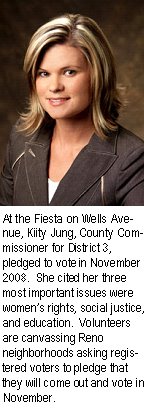
On Sunday, volunteers once again gathered in front of the US Bank at Wells and Vasser. This time they were preparing to work the crowds that were here to enjoy the first annual Fiesta at Wells Avenue. According to the Reno Gazette Journal, more than 5,000 people had attended the Wells Avenue event by 3:30 p.m. The volunteers from PLAN worked from 11:30am to 3pm. Again the reactions from the people were very positive. County Commissioner Kitty Jung, who was out to enjoy the cultural events and festivities, paused to chat with volunteers and signed on pledging to vote in the up-coming elections in November. Commissioner Jung stated her 3 most important issues were women's rights, social justice, and education. She took the time to walk and chat with several of the volunteers and explain her position and duties as a county commissioner and commended the volunteers for their "fine work." Jorge Castro was able to register 5 new voters that afternoon. This is the Civic Engagement Initiative's second special event during the campaign. The first was at UNR's Annual Night of All Nations held at UNR's Lawlor Events Center. The two special events gathered 38 pledges and voter registrations. The initiative has gathered 83 pledges and voter registrations since its inaugural event on the 12th of April. THANKS TO ALL OUR VOLUNTEERS FOR THEIR HARD WORK AND DEDICATION!

Saturday, April 12, 2008

Passing the torch: Engaged in volunteerism and determined to make the world a better place

A component of the PLAN's Civic Engagement Initiative is combating voter apathy and increasing voter participation. Phase One of the initiative is targeting a half dozen voter precincts within Reno over the next 6 weeks that have demonstrated traditional low voter participation. Registered voters in Nevada will help select the next PRESIDENT OF THE UNITED STATES. In the contest for the presidency in 2004, Kerry and Bush were in a dead heat with Kerry holding 49% and Bush trailing with 48%. At the stroke of midnight on the 3rd of November, Nevadans chose President Bush over John Kerry 50% to 47% — moving the state's 5 electoral votes into the Bush column. It was a margin of 3%. Although Nevada has historically leaned Republican, the high concentration of labor unions and the Hispanic-American vote make it a potential battleground state. (Its 2006 Gubernatorial election was particularly competitive, and Republican Jim Gibbons won only by a slim margin.) The Las Vegas metropolitan area with its dramatic increase in population has become an attractive destination for Democratic campaign resources, and Republicans are buoyed by the strong disapproval ratings of Gibbons (29% approval rating as of March 2007) and Bush (34% approval rating as of March 2007). Furthermore, Nevada has, with the single exception of 1976, been won by the victor of every US Presidential election since 1912, a record which makes it a secondary bellwether state. The 2008 election is vital to the important issues that will impact and affect the future our social and educational institutions, national security, foreign trade and relations, our environment and the future of ALL NEVADANS.

The Civic Engagement Initiative is asking all registered voters to give their pledge that they WILL vote in November of 2008. Volunteers from the community, local organizations and TMCC High School spent their Saturday morning canvassing approximately 250 homes in Voter Precinct #1018, which is south of the Nevada Museum of Art and west of Virginia Street, knocking door to door asking registered voters to pledge that they will participate in the up-coming national election in November. Each volunteer was paired with another and hit the streets armed with voter registration applications and pledge sheets and worked in groups of two. Kat Baltierra and Jorge Castro teamed up and set a record of 12 pledges and 2 new voters registered. Kat, who is a senior at TMCC High School, stated that people were very excited to see young people actively participating in our democratic process and added that people generally had a positive attitude towards the volunteers. Her partner, Jorge, agreed, stating that people were happy to engage the young activists in a 'chat' about the issues. Another volunteer, Joe Togoan, who had done similar projects for the Democratic Party here, said that it was also important to convey to the residents and voters that this initiative was a non-partisan effort. Joe was also teamed up with another TMCC High senior, Amanda Gabbert. Their team was able to secure two pledges and register two new voters. The training the volunteers underwent at PLAN stressed this aspect of the initiative. Ireri Rivas, who coordinates the program, stated that these areas are very diverse and contain mixed communities of varying socio-economic levels and political orientation, avoiding heated debates and maintaining a "smile" and a neutral non-partisan stance is important in securing peoples' pledges. The volunteers also disseminated information to several residents who were ex-felons on how they can reinstate their voting rights. As, Langston Hughes once penned, "Out of the rack and ruin of our gangster death, the rape and rot of graft, and stealth, and lies, WE, the people, must redeem the land, the mines, the plants, the rivers. The mountains and the endless plain-- All, all the stretch of these great green states-- And make America again!" In the United States, approximately 70% of the eligible population registers to vote, which may be an important contributing factor in the low average election turnout, and in recent decades just barely has topped 50% of voting age population in presidential elections. However, in 2004, election turnout was up to 64% of the voting age US citizens. In the early, caucuses and primaries, including Nevada's caucus, according to csmonitor.com, the "Millennials," as sociologists have dubbed the youth vote; have already shaken up the presidential primary races with their surprisingly large turnouts in the Iowa caucuses and the New Hampshire primary at 13 percent and 43 percent respectively. It is the hope of the organizers at PLAN to continue that positive momentum and increasing the avenues for educated civic participation in our democratic process. Thanks to all the volunteers who participated in the event and for giving up their Saturday morning.

Wednesday, August 29, 2007

Town Hall Meeting Reno NV 28 Aug 2007


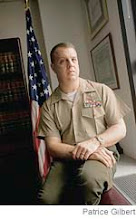
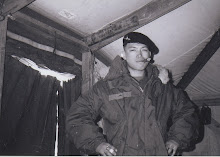
My name is Joaquin Rafael Roces. I have lived in Nevada since 1979. I grew up in Reno, and I was part of the third graduating class of McQueen High School in 1985. I have worked and lived in Fernley and Fallon. Among other things, I was a rodeo cowboy, a bull rider, Nevada is home to me. I want to preface what I am about to say with the comment, that I did not serve in a war like Al Gore, nor was I awarded the Purple Heart as was John Kerry. I was never a prisoner of war, and I am certainly no son of a President. I want to make it clear to everyone here, I am no hero. What I am is a Marine, I served as a rifleman with Kilo Company, 3rd Battalion, 2nd Marines, 2nd Mar Div, FMFlant. In 1987, during training and security operations in the Republic of the Philippines, during an armed coup against the then President Acquino, I was wounded in the line of duty and medically retired. I am a registered Republican, a naturalized US Citizen, and a disabled veteran. I served in two commissions under Governor Guinn and voted for Gov. Gibbons, and supported both through most of their political careers. I am no hero. I am a single working father, a first generation immigrant, trying to provide a better life for my sons, who, God willing, I will have the fortune of seeing grow into honorable manhood.

So forgive me, if I should seem a little uncomfortable with these proceedings as I am not a very good public speaker, and this is certainly way out of my comfort zone. However, I learned in the Marine Corps that comfort is an illusion born of familiar things and familiar ways; a tissue thin lie; a false sense of security that in of itself breeds mediocrity and complacency. It narrows the mind; weakens the body; and robs the soul of its spirit and determination. Comfort, the Marine Corps has taught me, is an illusion. Robert Kennedy once said it is not just bravery under fire or the bravery to make sacrifices, but the bravery to discard the comfort of illusion, to do away with false hopes and alluring promises. Reality is grim and painful, but it is only a remote echo of the anguish that a policy and agenda founded on illusion is sure to take us. The Bush doctrine, developed under the National Security Strategy (issued in 2002), advocates for the pre-emptive use of military power for self-defense and national security, if it is intended to assert a right available to the United States alone, is a policy founded on illusion. If it is intended to assert a new legal principle of general application, its implications, according to Richard Gardner, former Deputy Assistant Secretary of State, are so ominous as to justify universal condemnation. For such a doctrine would legitimize preemptive attack by Arab Countries against Israel, by China against Taiwan, by India against Pakistan, and by North Korea against South Korea, just to cite some obvious examples from Mr. Gardner. It would even serve to legitimize ex post facto use of such power as Japan’s attack on Pearl Harbor. Already, its application has rippled out from its epicenter at the Oval Office: Israel’s strike against Hizzbolah in Lebanon and Ethiopia’s Pre-emptive strike on Somali rebel forces- both occurred in 2006. Ethiopia's prime minister, Meles Zenawi, said Ethiopia entered hostilities because it faced a potential threat to its own borders. “Ethiopian defense forces were forced to enter into war to protect the sovereignty of the nation,” he said. “We are not trying to set up a government for Somalia, nor do we have an intention to meddle in Somalia's internal affairs. We have only been forced by the circumstances.”

Henry Kissinger, who is certainly not known for his dedication to International law, put the matter succinctly in a column for the Washington Post:

“As the most powerful nations in the world, the United States has a special unilateral capacity to implement its own convictions. But it also has a special obligation to justify its actions by principles that transcend the assertions of a preponderant power. It can not be in either the American national interest or the world’s interest to develop principles that grant every nation an unfettered right to pre-emption against its own definition of threats to its security.”

Those principles are embodied within the framework of our Constitution. (Korematsu v. United States- 1994), Justice Robert Jackson warned that a military order, however unconstitutional, is not apt to last longer than the military emergency. Justice Jackson adds, but once a judicial opinion rationalizes such an order to show that it conforms to the constitution, or rather rationalizes the Constitution to show that the Constitution sanctions such an order, the court for all time has validated that principle. Thus that principle then lies about like a loaded weapon ready for the hand of any authority that can bring forward a plausible claim of an urgent need. Voltaire put it simply, “Those who can make you believe absurdities can make you commit atrocities.” From the illusion of weapons of mass destruction and imminent harm from Saddam Hussien and Iraq, we have the dismantling of our civil rights under the Patriot Act, the national shame at Abu Ghirad and Guantanomo, the death of 3700 Americans, approximately 40 from this state alone, and an endless conflict that has already outstretched both World War I and II as well as the Korean War from 1951-1953.

Beyond the human cost, the financial and economic repercussions of “staying the course” at $9 billion per month, on top of an initial outlay of up to $13 billion for the deployment of troops to the Persian Gulf region will not be felt for years to come. According to the nonpartisan Congressional Budget Office (CBO), they estimated the cost of "prosecuting" a war against Iraq at up to $9 billion per month, on top of an initial outlay of up to $13 billion for the deployment of troops to the Persian Gulf region.

Summary of Iraq War Cost Estimates
CBO estimated the following costs for an Iraq war:

  • Initial deployment of troops: $9 billion to $13 billion
  • Conducting the war: $6 billion to $9 billion per month
  • Returning forces to US: $5 billion to $7 billion
  • Temporary occupation of Iraq: $1 billion to $4 billion per month

In comparison, from 1941 until 1945, during the Second World War, President Roosevelt paid for war effort by selling Bonds to the US public. The US had 7 bond drives to raise funds to support the war effort. By the 7th Bond drive, shortly after the battle for Iwo Jima, the US government was literally broke. The 7th Bond Tour raised $24 Billion (1945 Dollars) for the US Treasury, more than any other bond tour. To put this into perspective, the total US Budget in 1946 was $56 Billion. This would be the largest borrowing from the American public in history. Today the President can just spend our money on war without consulting us, the taxpayers. As of today according to the National Priorities Project the cost of the war in Iraq is $455,937, 345,134 and Nevada’s share of that is $4,084,357,618.

The debate about Iraq in Washington also centers around an illusion of a false choice: Do we continue with President Bush's failing course and hand the problem off to the next President? Or do we just turn our backs and hope for the best? Like Somalia? Like Rawanda? Like Darfur?

In 1975, the US signed a Peace treaty in Paris and made a commitment to its South Vietnamese allies that the US would intervene if the North invaded South Vietnam. When President Nixon was impeached, the North saw their opportunity and invaded South Vietnam, America ignored its treaty obligations and thousands were slaughtered and buried in mass graves, while thousands more fled the country in make-shift boats.

There is a third way. Leslie Gelb, President Emeritus of the Council on Foreign Relations, has proposed a five-point plan to keep Iraq together, protect America's interests and bring our troops home. I recognize that while leaving Iraq is necessary, it is not a plan in of itself. The vague campaign promise “That if elected president, I will end the war in Iraq” is nothing more than a bright and shining lie. President Eisenhower sent 14,000 Marines and Soldiers to Lebanon in 1958, President Reagan sent 1800 Marines in 1982-1984, and in 2006, our band-aid –on-a-sucking-chest-wound approach to the Middle East ruptured again. We need a plan for what we leave behind, so that America's interests and security are protected, and future generations need not put their lives at risk for what we left undone.

In 1975, civil war and sectarian violence erupted in Lebanon and after 7 years of bloodshed, US Marines along with French Legionnaires and Italian and British soldiers entered the conflict as part of a peacekeeping effort. Phillip Habib, Special Envoy to the Middle East was shuttled along the warring parties on Marine Corps and Navy transports – this would give birth to the term “Shuttle Diplomacy.” The Marines and their counterparts were used to buffer the warring parties until a diplomatic solution could be reached. The tragic events of October 2003, led to the deaths of 241 Marines and soldiers, and by the spring of 1984, America was withdrawing its forces from the conflict. War and sectarian violence would continue. Israel would not withdraw its troops until 2000 and Syria’s military would not follow until 2005. Lebanon still bears deep scars from the civil war. In all, it is estimated that more than 120,000 people were killed, and another 100,000 handicapped by injuries. Approximately 900,000 people, representing one-fifth of the pre-war population, were displaced from their homes. Perhaps a quarter of a million emigrated permanently. Lebanese victims of kidnapping and wartime "disappearances" number in the tens of thousands - over 17,000 civilians, are still missing. Unresolved ethnic tensions that were left behind and ignored in 1983, resurfaced last summer with a new Israeli offensive and renewed ethnic fighting that continues today.
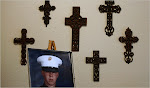
Sectarian violence among Shiites, Sunnis and Kurds is now the major impediment to stability and progress in Iraq. Like Lebanon, no number of troops can solve that problem. The only way to hold Iraq together and create the conditions for our armed forces to responsibly withdraw is to give Shiites, Sunnis and Kurds a way to share power peacefully. That requires a sustainable political settlement, which is the primary objective of the plan.

The plan would maintain a unified Iraq by decentralizing it and giving Kurds, Shiites and Sunnis local control over their daily lives - as provided for in the Iraqi constitution. The central government would be responsible for common interests, like border security and the distribution of oil revenues. We would secure support from the Sunnis - who have no oil -- by guaranteeing them a proportionate share (about 20 percent) of oil revenues and reintegrating them into society. We would increase economic aid, ask the oil-rich Arab Gulf states to fund it and tie all assistance to the protection of minority rights and the creation of a jobs program. We would initiate a major diplomatic offensive to enlist the support of Iraq's neighbors and create an Oversight Group of the U.N. and the major powers to enforce their commitments. And we would ask our military to draw up plans to responsibly withdraw most U.S. forces from Iraq by the summer of 2008 - enough time for the political settlement to take hold - while leaving a small force behind to take on terrorists and train Iraqis. Keep in mind the US began withdrawing its 1800 troops in the spring of 1984 and it took almost a year to fully withdraw disengage all personnel. During the Gulf War in 1991, U.S. troop strength in the Middle East were reduced by 45 percent to 300,000, down from the peak of 540,000 between the war's end on Feb. 28 and Apr. 14. About 5,000 troops were leaving every day after that. At that rate, evacuating the remaining 300,000 would have taken another 60 days. But sectarian fighting in the north and south complicated the withdrawal and disengagement as residual forces remained to oversee no-fly and no-drive zones. We have over 105,000 troops with supporting infrastructure in Iraq today. We continue to have a military presence in Bosnia a decade after the end of hostilities.

There is no purely military solution to the sectarian civil war. The only way to break the vicious cycle of violence – and to create the conditions for our armed forces to responsibly withdraw -- is to give Shiites, Sunnis and Kurds incentives to pursue their interests peacefully. That requires an equitable and viable power sharing arrangement. That’s where this plan comes in. This plan is not partition – in fact, it may be the only way to prevent violent partition and preserve a unified Iraq. This plan is consistent with Iraq's constitution, which provides for Iraq's 18 provinces to join together in regions, with their own security forces, and control over most day-to-day issues. This plan is the only idea on the table for dealing with the militia, which are likely to retreat to their respective regions. This plan is consistent with a strong central government, with clearly defined responsibilities. Indeed, it provides an agenda for that government, whose mere existence will not end sectarian violence.
The example of Bosnia is illustrative. Ten years ago, Bosnia was being torn apart by ethnic cleansing. The United States stepped in decisively with the Dayton Accords to keep the country whole by, paradoxically, dividing it into ethnic federations. We even allowed Muslims, Croats and Serbs to retain separate security forces. With the help of U.S. troops and others, Bosnians have lived a decade in peace. Now, they are strengthening their central government, and disbanding their separate security forces.

President Bush does not have a strategy for victory in Iraq. His strategy is to prevent defeat and to hand the problem off to his successor. As a result, more and more Americans understandably want a rapid withdrawal, even at the risk of trading a dictator for chaos and a civil war that could become a regional war. Both are bad alternatives.
At the start of my speech, I used a quote from Robert Kennedy who said it is not just bravery under fire or the bravery to make sacrifices, but the bravery to discard the comfort of illusion, to do away with false hopes and alluring promises. I believe this is a great nation and a great people. Any who seek to comfort rather than speak plainly, reassure rather than instruct, promise satisfaction rather than reveal frustration; they deny that greatness and drain that strength. In closing, I think it an appropriate reminder that our freedom is not assured by the brilliance of our weapons, the greatness of our army, or the rhetoric of our noble leaders; it assured by the Constitution and the core principles embodied within. As a Marine Rifleman that is what I was sworn to defend above all else, against all enemies foreign and domestic. It is not about the Republican answer or the Democratic answer, but the right answer. The test of this new presidency is not about who is to blame for the past; but who will accept responsibility for our future.
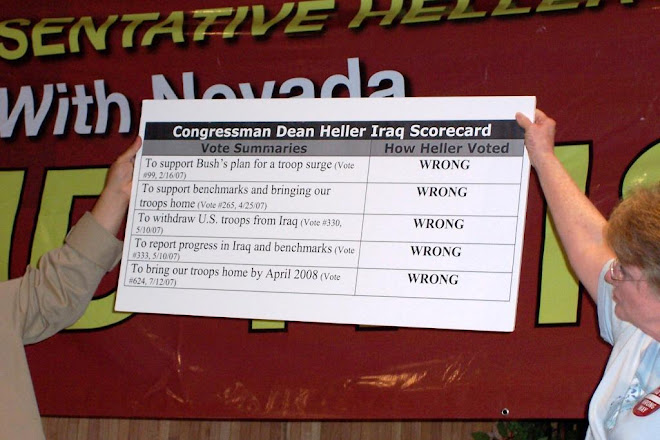
Today, democrats, republicans and independents have come together to urge Dean Heller to change his position on the Iraq War. I was disheartened to learn that the White House and not General Petraeus, will give the the "Progress" report on Iraq next month. After more than four years of war, I no longer trust this administration and its false illusions and bright and shining lies. But most disheartening is Dean Heller's refusal to attend this town hall meeting and explain to us face to face why he continues to block an end to the war.