Working with the Progressive Leadership Alliance of Nevada (PLAN), as a part of their Civic Engagement Project, I will be travelling around the Truckee Meadows working to educate the voters and residents of the area on two very important potential up-coming ballot questions.that impact Northern Nevada and the Truckee Meadows, the "Save our Water" And "Stop Leap Frog Development" campaigns. These are two potential up-coming ballot questions that the Alliance is currently involved in working to inform voters on. The 'Leapfrog development' question is an attempt to rein in a very aggressive annexation policy by the cities in the Truckee Meadows. A similar attempt was made to change the current law last year which failed. For example, Reno has moved from a cherry stem annexations, like Cold Springs and Verdi, to a non-contiguous annexation such as the Winnemucca Ranch area leapfrogging 25 miles north to the border of Pyramid Lake. This type of non-contiguous urban sprawl put unnecessary strain on public infrastructure and public safety resources and complicates jurisdiction and service issues. Successful passage of this initiative would not 'cap' growth, but merely 'manages' it in a reasonable and responsible way by encouraging developers to redevelop areas closer in and the burden and costs to exisiting residencent and voters would significantly decrease for road construction as well as for other public service and infrastructure under a more compact and responsible form of development. Paasage of this initiative would put the regional plan back in compliance with state annexation laws which forbid the cities to annex non-contiguously. What this ballot initiative refers to is "voluntary annexation" which is the type of annexation being used by the cities and developers to subvert the state law, by having a developer buy a ranch or property, and then asks the city for a "voluntary annexation." The very lifestyle that generations of Nevadans have been raised on, and brings people to our region is being threatened by out of control development and irresponsible management. Alan Weber, a noted columnist, visited our area and compared it to Portland and Denver. Weber lauded Portland, OR, as an example of controlled, sustainable growth, and derided Denver as a region where "a gorgeous state" with amble natural beauty "let sprawl and development override the beauty of open space and mountains." To the people of Reno and Sparks, Weber had this to say, "the Reno-Sparks area still has time to choose its direction."
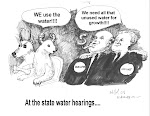
In regard to the 'Save our Water' question, the current master plan for our area calls for 1.2 million residents, while we only have enough water for about 600 thousand residents. In Planning Principle #2 of the Truckee Meadows Regional Plan, it is recognized that our region is "resource constrained" and that water is one of the resources that is constrained. Again, this is not an attempt to stop or 'cap' growth, but again to manage it in a responsible manner. The Truckee Meadows Regional Plan water demand estimates exceed identified water resources by 120%. Washoe County Commissioner Bob Larkins at the Board of County Commissioner meeting held on 3/11/08 conceded that the Spanish Springs area is already "over-allocated" in terms of water needs and usage. The voters of Washoe County have a right to determine the future of the region. The irresponsible and unmanaged growth in Las Vegas has already put our state's and regions water supply at risk.
Lessons from LAS VEGAS -- Seting aside what happened to the Owens Valley, in this city of histrionic and runaway growth (in 2005), in the middle of a five-year drought, the worst in 100 years of record-keeping and perhaps -- tree rings suggest this -- the worst in 500 years, Las Vegas's water came mostly from Lake Mead -- which in 2005, was down to 59 percent of capacity -- and, upstream from Mead, Lake Powell, which was at 34 percent of capacity, its lowest since it started filling three decades before. The Colorad River doesn't even reach the Gulf of Mexico anymore. The lower course of the river, which forms the border between Baja California and Sonora, is essentially a trickle or a dry stream today due to use of the river as Imperial Valley's irrigation source. Prior to the mid 20th century, the Colorado River Delta provided a rich estuarine marshland that is now essentially desiccated, but nonetheless is an important ecological resource.
The Strip -- the portion of Las Vegas Boulevard that has 15 of the world's 20 largest hotels -- features vast fountains, a sea battle between pirate ships and an 8.5-acre lake in front of the Bellagio Hotel and Casino. According to ABC News (April 2007) Las Vegas has become the fastest-growing city in the nation. Its population is currently 1.8 million, and is projected to hit 3 million by 2020. Las Vegas is a city with a ferocious thirst that it's having a hard time slaking. The major water supply for Las Vegas comes from the Colorado River, which has undergone a drought as a result of climate change, says Pat Mulroy, of the Southern Nevada Water Authority.
"Climate change is here," Mulroy, the city's water czar for almost 20 years, says. "We've been living it for the last eight years. The drought on the Colorado River was a rude wake-up call. Frankly, when 90 percent of your water comes from one river that is predicted to have massive water shortages, you'd be irresponsible not to develop water supplies that are independent of that river system in order to diversify." The plan for diversification is controversial. Mulroy divised the controversial plan to build a $2 billion pipeline that would pump water out of White Pine County and send it down to feed the growing water needs of southern Nevada. Specifically, the Snake Valley, in White Pine County, Nev., straddling the Utah border. This area is home to cattle ranches, alfalfa farms and endangered species, it's people who are few and far between along this desert landscape. That's because the Snake Valley is dry -- one of the driest parts of the driest state in the union, getting only about 8 inches of rainfall every year.
The Southern Nevada Water Authority and its water "czar," Patricia Mulroy, seeks to tap 65 billion gallons of rural water a year with a 300-mile-long pipeline expected to cost more than $2 billion. That's enough water for 50,000 families a year. Las Vegas's unmanaged growth has now impacted other Nevadans, like Dean Baker and Cecil Garland, who both operate ranches in Utah and Nevada. But even the Water Czar could not avoid conceding "There isn't enough water to go around," Mulroy told NPR in a 1991 story about the early stages of the project. "And we're the most arid spot in the United States." Las Vegas, a city known for its excess, has exceeded not onlt its own surface and ground water sources, as well as the Colorado River, but now expect other Nevada communities and families to sacrifice their life styles and communities for the sake of unmanaged growth. "What Las Vegas has got to learn is that there are limits to its growth," Garland says. He also applies his own value judgment to the competing uses for water. "Gluttony, glitter girls and gambling are what [Las Vegas] is all about," the 81-year-old rancher asserts. "What it's all about here [in Snake Valley] is children, cattle, country and church."
It is quite simply reckless and irresponsible to implement any growth plan that ignores or fails to consider the availability of water in Washoe County, and to ask other communities in our state to pay far or shoulder the burden of our lack of responsible planning.
The research for this article was provided by the Progressive Leadership Alliance, by Howard Berkes of NPR, by Terry Moran and Katie Hinman, ABC News, and George F. Will of the Washington Post.
Showing posts with label Roces. Show all posts
Showing posts with label Roces. Show all posts
Friday, March 28, 2008

Thursday, November 15, 2007
a history lesson
This article was submitted as a response to Mr. al-Zawahri's comments published by the New York Times. The response was submitted via email to the New York Times, al-Jazeera and the Reno Gazette Journal in 2006.
Mr. Ayman al-Zawahri’s comments in his latest recorded message released by al-Jazeera and the New York Times on
In the name of God the Compassionate, the Merciful
“There are some who declare, ‘we believe in God and the Last Day,’ yet they are not true believers. They seek to deceive God and those who believe in Him: but they deceive none save themselves, though they may not perceive it. There is a sickness in their hearts which God has aggrevated: they shall be sternly punished for the lies they tell.
When they are told: ‘You shall not do evil in the land,’ they reply: ‘Surely we are doing only what is good.’ But it is they who are the evil-doers, though they may not perceive it.”
-Al Baqarah (
Does al-Zawahri really believe that he can fool the Shiites with a second Abbassid betrayal? After the rise of Shiism under Muktar in 686 A.D., descendants of Al-Abbas, an uncle of the Prophet, peace and blessings be upon him, assumed the mantle of leadership within the Shiite movement in 716 A.D. The Abbasids deceived the Shiites and used them to challenge the Omayyad Caliphate by pretending to subscribe to Muktar’s designated line of Imams descending from Muhammad ibn al-Hanafiyya, a son of Ali’s, the Abbassids claimed their bloodline flowed like theTigris from the ahl-al-bayt, the Prophet’s bloodline, peace and blessing be upon him. At this time many Shiites supported the claim that Imamate flowed to Muhammad ibn Ali, the great grandson of al-Abbas, and thus believed the Abbassid deception. In 749 A.D. the Abbassids with the help of the Shiites defeated the Omayyad forces at Kufa, and Abu al-Abbas was proclaimed the first Abbassid Imam. The following year, the Abbassids drove the Omayyads from
Bin Laden’s earlier struggle against the Soviets was an attempt to resurrect this system by defending members of the Ummah against external enemy. Bin Laden saw the Soviet invasion of
Now back to the history lesson. For three decades after establishing their Imamate, the Abbassids preached their belief of the legitimacy of the Alid line and the sanctity of the lineal descendants of Ali. However, immediately after the Abbassid secured their dynastic rule, they betrayed the Alid faithful who had helped them secure victory in the first place. In order to be accepted by the Muslim majority, the Abbassids rejected their Shiite roots and declared themselves a Sunni dynasty following not the Alid line, but Abu Bakr’s lineage. They instituted violently repressive measures against the Alid faithful, which included summary executions, imprisonment and massacres. This pattern of oppression and intimidation was evident under Saddam Hussein’s regime that violently oppressed a Shi’a majority in
Not only were the Alid faithful targeted, but their holiest cities and shrines were desecrated as well. Both
I am not condoning Hizzbolah’s attacks on
Al-Zawahri can not deny that niether his master nor he has enjoyed the recognition that Hizzbolah’s leader has enjoyed. There were no mass demonstrations of Muslims carrying portraits of al-Zawahri or bin Laden, but Sheik Nasrallah of Hizzbolah has been elevated to a folk hero status as Muktar was. After the death of Husayn ibn Ali in Karbala, Muktar gathered Husayn ibn Ali’s remaining followers and formed the Army of the Penitents and avenged Husayn’s death by defeating the very assassins who had murdered Husayn. Upon this victory the Abbassids built their deception and stole the holy lands from the Shiites placing their capital in Baghdad, now al-Zawahri wishes to do the same with Nasrallah’s fame, to decieve the Alid faithful once again. For once, in a democratic Iraq, the Alid faithful can once again control the sacred lands of their faith. The Alid faithful must learn their own history and should not fall for al-Zawahri’s lies. As Mowlana Julaluddin Rumi once wrote: “I am God’s Lion, not the lion of passion…I have no longing but for the One. When the wind of personal reaction comes, I do not go along with it. There are many winds full of anger, and lust, and greed. They move rubbish around, but the solid mountain of our true nature stays where it’s always been.” Al-Zawahri’s message is like these false winds that move rubbish around and the Shiites must stand as God’s Lion, as the mountain, unmoved by the lies of Al-Zawahri and his master. La ilaha illa Allah; Allahu akbar.
*********************
See Britain's MI-5 assessment of Al Queda's Ideology at:http://www.mi5.gov.uk/output/Page546.html
Monday, September 3, 2007
In the line of fire
In the line of fire
By Joaquin R Roces
(This article was submitted to Economist, the New York Times and the Reno Gazette Journal on August 2006)
My name is Joaquin Rafael Roces, I was at one time a Marine rifleman with Kilo Company, 3rd Battalion, 2nd Marines, 2nd Marine Division, Fleet Marine Force Atlantic. I am writing in regard to the Newsweek Article Anatomy of a Revolt written by Evan Thomas and John Barry in the April 24th issue. First I want to make it clear that I stand by Generals Zinni and Newbold as well as the other generals who have come forward to criticize the Secretary of Defense and this administration’s handling of the war. Voltaire once mused, “It is forbidden to kill; therefore all murderers are punished unless they kill in large numbers and to the sound of trumpets.” Perhaps it is with that sentiment that Robert McNamara, Secretary of Defense during the Vietnam War (1961-1968), on reflecting on his involvement in that war, reflected that “Any military commander who is honest with himself, or with those he's speaking to, will admit that he has made mistakes in the application of military power. He's killed people unnecessarily — his own troops or other troops — through mistakes, through errors of judgment. A hundred, or thousands, or tens of thousands, maybe even a hundred thousand. […] And the conventional wisdom is don't make the same mistake twice, learn from your mistakes.” Almost mimicking the confrontaton between, Bruce Greenwood’s National Security Advisor character and the Marine officer played by Tommy L. Jones in James Webb’s “Rules of Engagement,” an unprecedented confrontation between the professional soldiers and their civilian leadership has unfolded and is reaching a crescendo. Not even in the hieght of the Vietnam war, with all its unpopularity and protest, did such a thing happen.
But perhaps it is the very same ghosts that haunt Mr. McNamara now, that haunts these generals as well. Many of whom cut their teeth and earned their blood stripes in that conflict. Another Vietnam player was General Harold K. Johnson who was the Army Chief of Staff. In reflection, General Johnson expressed that he intended to tell President Lyndon Johnson that “You [Pres. Johnson] had required me to send men into battle with little hope of the ultimate victory and you have forced us to violate almost every one of our principles of war in Vietnam,” and with that General Johnson intended to quit and walk out the door. But he did not, and according to his memoirs and biography recorded by Lewis Sorley, before he died General Johnson lamented that he was going to his grave “with a burden of a lapse of moral courage” on his back. The lesson of which General Batiste studied at the Army’s War College some years later, and the same post held by General Shinseki before he was asked uncermoniously “to fade away.”
I am reminded of a quote from General George S. Patton, “If everybody is thinking the same thing, then somebody isn’t thinking.” According to the Thomas and Barry piece in Newsweek, in the winter of 2003, Army Chief of Staff General Eric Shinseki was alone among the administration’s top brass in warning Congress that occupying
At the time of the Newsweek article there were over six Generals who have come forward to criticize the SecDef and the administration as a whole for the handling of the war on
The most scathing criticism came from another Marine, Lieutenant General Gregory Newbold, who was chief of operations of the Joint Staff during the planning stages of the second Iraq War. In the Newsweek article General Newbold was quoted as saying the decision to invade
However; as an officer, General Powell also valued loyalty very highly, and as a result, did not usually undermine policies he disagreed with after they were implemented. Thus, while initially opposing the plan that would become Operation Desert Storm, Powell nevertheless supported it once it became official policy, and gave it his full dedication. A strategy he outlined for Operation Desert Storm, the use of "overwhelming force" to achieve a military objective while minimizing U.S. casualties, became known as the "Powell Doctrine". The Doctrine follows from principles laid out by Caspar Weinberger, Ronald Reagan's Secretary of Defense following the bombing of the Marine Barracks at Beriut in 1983 (for discussion see MY AMERICAN JOURNEY: COLIN POWELL, with Joseph E. Persic, ©Random House Publishing)
-->Is a vital
-->Will we commit sufficient resources to win?
-->Are the objectives clearly defined?
-->Will we sustain the commitment?
-->Is there reasonable expectation that the public and Congress will support the operation?
-->Have we exhausted our other options?
-->Do we have a clear exit strategy?
The questions posed by the Powell Doctrine:
-->Is a vital national security interest threatened?
-->Do we have a clear attainable objective?
-->Have the risks and costs been fully and frankly analyzed?
-->Have all other non-violent policy means been fully exhausted?
-->Is there a plausible exit strategy to avoid endless entanglement?
-->Have the consequences of our action been fully considered?
-->Is the action supported by the American people?
-->Do we have genuine broad international support?
Yet none of this was applied to the second Gulf War. Somehow the words of caution did not sink in and Gen. Powell is no longer the Secretary Of State. Another “old soldier” fades away. Why was the Powell Doctrine that was so successful in the first Gulf War, discarded so easily the second time round? Thomas and Barry assert that the senior military did not force a discussion of what to do after the war was won. They charge that the SecDef was obsessed with the plan of attack, but not the aftermath. It would appear that risks and costs were not fully or frankly analyzed by the senior military and by the administraton. In a televised interview with Britain’s ITV, then Secretary of State Powell stated that he had asked for a larger number of troops to be deployed to Iraq, saying that “the case was made, it was listened to, it was considered (…) A judgment was made by those responsible that the troop strength was adequate. And so it was not anything that was ignored, it was considered and a judgment was made by those responsible for making military judgements that the troop strengths were adequate.” Again somebody was not thinking like everybody else.
“Miller!” the Marines called from below. “Miller!”
With that the Marines’ near mystical commandment against leaving a comrade behind siezed the group. One after another, the young Marines dashed into the minaret, into darkness and into gunfire, and wound their way up the narrow stairway. For them the battle for
After four attempts Lance Cpl. Miller’s lifeless body emerged from the tower, his comrades choking and covered with dust. With more insurgents closing in, the Marines ran through volleys of machine gun fire with their comrade in tow carrying him back to their base.
The consequences are now painfully iretractable facts: Rumsfeld demanded a swift, lean force that worked brilliantly to topple the Hussein Regime, but was woefully inadequate to take over the more onerous task of securing and rebuilding
General Zinni is qouted by Newsweek as saying “We are paying the price for…the lack of a plan.” It is of course ridiculous and absurd to think that there was no plan or concerted effort, it would be reckless for me or any General to imply that. But that is not what General Zinni is saying. As General Powell intoned earlier, that a plan and strategy “was made by those responsible for making military judgements.” General Zinni spent more than 40 years serving his country as a warrior and diplomat, rising from a young lieutenant in Vietnam to a four-star general with a reputation for candor. From 1997 to 2000, he was commander-in-chief of the United States Central Command, in charge of all American troops in the
Following his retirement from the Marine Corps, the Bush administration thought so highly of Gen. Zinni that it appointed him to one of its highest diplomatic posts -- special envoy to the
The company of 185 Marines of Echo Company, part of a lionized battalion, 2nd Battalion, 4th Marines, nicknamed the Magnificent Bastards, is also one of fortitude and ingenuity. The Marines, based in a junkyard in Ramadi, had been asked to rid the provincial capital of one of the most persistent insurgencies, and in enduring 26 firefights, 90 mortar attacks and more than 90 homemade bombs, they shipped their dead home and carried on. Their tour has become legendary among other Marine units now serving in
On
In parceling out Ramadi, the Marine Corps leadership gave Echo Company more than 10 square miles to control, far more than any of the battalion's other companies. Captain Royer said he had informally asked for an extra platoon, or 44 Marines, and had been told the battalion was seeking an extra company. The battalion's operations officer, Maj. John D. Harrill, said the battalion had received sporadic assistance from the Army and had given Company E extra help. General Mattis says he could not pull Marines from another part of
Captain Royer said more armor would not have even helped. The insurgents had a .50-caliber machine gun that punched huge holes through the Humvee’s windshield. Only a heavier combat vehicle could have withstood the barrage, he said, but the unit had none. According to Moss’ account Defense Department officials have said they favored Humvees over tanks in
Not all the officers swept aside were general grade officers. Captain Kelly D. Royers was the skipper of Echo Company. Lt. Sean J. Schickel remembered Captain Royer asking a high-ranking Marine Corps visitor whether the company would be getting more factory-armored Humvees. The official said they had not been requested and that there were production constraints, Lieutenant Schickel said. It is striking to note that when the SecDef visited
Meanwhile inside the beltway, the Senate voted to spend an extra $213 million to buy more fully armored Humvees. The Army's procurement system, which also supplies the Marines, has come under fierce criticism for underperforming in the war, and has only one small contractor in
Captain Royer was later relieved of command. General Mattis and Colonel Kennedy declined to discuss the matter. His first fitness report, issued on May 31, 2004, after the company's deadliest firefights, concluded, "He has single-handedly reshaped a company in sore need of a leader; succeeded in forming a cohesive fighting force that is battle-tested and worthy."
The second, on
US Army General John Batiste said on CNN (April 2006) that the
Gen. Batiste warned, "When we violate the principles of war with mass and unity of command and unity of effort, we do that at our own peril,” words that resonate with the lessons of Gen. Johnson’s lack of moral courage. But this was not just an academic lesson Gen. Batiste learned in the
"You know, it speaks volumes that guys like me are speaking out from retirement about the leadership climate in the Department of Defense," Gen. Batiste said. The General stands out among the others in the fact that he was a top aid to Paul Wolfowitz during the planning stage of the war and commanded troops in theater as well. So admired was General Batiste that he was offered a promotion and a third star. It would make him the second highest ranking officer in
In January of 2006, the New York times obtained a 3 page Pentagon Report that was released by a Veteran’s Advocacy Group, Soldiers for the Truth, reported as many as “42% percent of the Marine casualties who died from isolated torso injuries could have been prevented with improved protection surrounding the plated areas of the vest (body armor)…another 23% could have been saved with side plates that extend below the arms, while another 15% could have benefited from shoulder plates.” The New York Times delayed release of the report for a week in order for the Pentagon to confirm the veracity of the report. Pentagon officials refused to comment. As of January of 2006, 526 Marines have been killed in combat in
Body armor has gone through a succession of problems in
Jack Kelly of the Jewish World Review, defended the Army’s procurement practices. Citing a Col. Thomas Spoehr who is the director of the materiel for the Army Staff, Kelly reports in his August 2005 article that the delays were caused by the Army’s insistence on taking “proactive steps” to improve the armor plating in the vests prior to production. These vests are known as the “Interceptor” and are, according to Kelly and Col. Spoehr, the “best body armor manufactured in the world today.” It was significantly improved from the ones worn by US troops in
Meanwhile Armor Holdings, the sole and small
Remember Echo Company who lost 10 Marines in a deadly firefight? Their Humvee was one that lacked even the improvised armor and was one waiting to be replaced by the back-logged Armor Holdings. Captain Royer admitted more armor would not have mattered because the insurgents had a .50-caliber machine gun that punched huge holes through its windshield. Only a heavier combat vehicle could have withstood the barrage, he said, but the unit had none. Defense Department officials have said they favored Humvees over tanks in
In a statement dated
Major General Charles Swannack who led the Army’s elite 82nd Airborne Division during its deployment in
Echo Company had less than half the troops who are now doing its job currently in Ramadi, and covered an area larger than any other company in their battalion’s sector. The unit had resorted to making dummy Marines from cardboard cutouts and camouflage shirts to place in observation posts on the highway when it ran out of men. During one of its deadliest firefights, it came up short on both vehicles and troops. Marines who were stranded at their camp tried in vain to hot-wire a dump truck to help rescue their falling brothers. That day, 10 men in the unit died.
Lance Corporal Miller’s unit, Bravo Company, 1st Battalion, 8th Marines, was the same unit bloodied in
On the first morning of the battle, Day One was not even half over, 45 Marines of Bravo Company’s third platoon darted across
First platoon would be caught in a nighttime ambush. Encountering insurgents dressed in Iraqi National Guard uniforms, the Marines waved as the insurgents opened fire. Corporal Anderson would die instantly and Private First Class Andrew Russell, lay bleeding in the road, screaming from a near severed leg. Again the Marines rushed forward to retrieve their comrades. After all, who else would?
Corporal Jake Knospler lost part of his jaw to hand grenade in a pitch black house. It was
On
Corporal Nick Ziolkoweski was nicknamed ‘Ski’ by his fellow Marines. In April of 2004, he sat on a roof top on the outskirts of the Shuhada neighborhood, an area controlled by insurgents. Already Ski was a proficient sniper with at least three confirmed kills. Prior to taking charge of his post at Shuhada, he was warned by intelligence officers, that the insurgents were targeting American snipers. He manned his post, and for a moment, he took his helmet off to get a better view through his scope. The bullet struck him in the head knocking backward onto the roof. I am reminded of an old Marine Corps Cadence that goes: “To Saint Peter I will tell, another Marine reporting, sir, I’ve served my time in hell.”
General Zinni voiced that it was his belief, as it was with the others, that Saddam Hussein was sufficiently contained with the UN Sanctions, the no-fly and no-drive zones. Echoing General Newbold’s comments that Iraq’a actions were only peripheral to the real threat, General Zinni says, “at the same time, we had this war on terrorism. We were fighting al Qaeda. We were engaged in
What about
Gen. Mike DeLong, Central Command’s Deputy Commander, insisted that there was no hard intel confirming Bin Laden’s presence in Tora Bora. In the same Frontline story, Gen. DeLong stated that to the best of Central Command’s knowledge they did not know Bin Laden was there. Gen. DeLong does admit that the CIA believed that Bin Laden was hiding in Tora Bora, “We had word from the agency [CIA] that he [Bin Laden] may have been wounded, but we never knew.” Mr. Bernsten’s Afghan contacts had indeed reported that Bin Laden had been wounded during a bombing mission. Mr. Bernsten presented a plan to Central Command’s Liaison in
Mr. Clarke disagrees with General DeLong citing that the administration and Central Command are sensitive about letting Bin Laden slip out the back door. Mr. Clarke is emphatic when he says that “Yes, we know he [Bin Laden] was absolutely there. He may have been wounded by fragments of an American bomb dropped up there. And, yes, he did escape…They did let him get away.” In his own book, The Unvarnished Truth About The Wars in Afghanistan and Iraq, Gen. DeLong notes his own conversation with the SecDef in which Gen. DeLong, citing difficult and hostile terrain, high altitudes and extreme weather conditions, advises the SecDef against the deployment of ground forces in Tora Bora. Yet this was the very terrain that the 10th Mountain Division was designed to operate and fight in. General Tommy Franks, in interviews and in his own memoirs which were quoted by New Yorker Correspondent Steve Coll in the Frontline piece, states his rational for not deploying the 10th Mountain Division into a blocking position in Tora Bora was his fear of inflaming local Afghan opinion with a heavy American military presence “putting a big, heavy occupying American footprint” in the heartland of Taliban country. Gen. Franks feared he would make matters worse at that stage. But the question is worse than what? What could possibly be worse than allowing Bin Laden to escape? Was not the capture and elimination of Al Qaeda and Bin Laden our priority and reason for going into
Fast forward three years on
At the time of Spec. Tillman’s death 110 Americans had died in
-->on 5 January, a bomb in Tirin Kowt, Oruzgan province killed ten people
-->on 15 January, an attack on a Canadian military convoy in
-->on 16 January, another bomb in
-->also on 16 January, a suicide-bomber in Spin Boldak (near Kandahar, on the Pakistan border) killed twenty people and injured twenty more; local police officers may have been among the casualties (see Ruhullah Khapalwak & Carlotta Gall, "24 killed in bomb blasts in southern Afghanistan", International Herald Tribune, 17 January 2006)
As of May 2006, American and coalition warplanes are flying 25-60 combat missions a day in
Remember Jessica and Lori? We lionized Army Private First Class Jessica Lynch and made a martyr of Private First Class Lori Piestewa, for their harrowing ordeal as Prisoners of War, and in the wake of Abu Ghurab, we have already forgotten the brutality they endured. There was also Specialist Shoshanna Johansen who suffered bullet wounds to her legs and was another Prisoner of War. As of June of 2005, according to CNN, thirty-nine female
In a report by CNN’s Jane Arraf, in June of 2005, a convoy returning to
Retired Colonel Douglas McGregor was interviewed for the Newsweek article and wrote the book, Breaking the Phalanx, which was influential in inspiring the military’s blitzkrieg assault on
Where is this course taking us? For the dissenting generals it is a path they have spent their careers avoiding. The US Military entrenched in an unpopular war that is increasingly appearing to be a civil war, to prop up a democracy in a country with heavy
Asked who was to blame, this general pointed directly at the SecDef and Deputy Defense Secretary Paul D. Wolfowitz. “I do not believe we had a clearly defined war strategy, end state and exit strategy before we commenced our invasion," he said. "Had someone like Colin Powell been the chairman [of the Joint Chiefs of Staff], he would not have agreed to send troops without a clear exit strategy. The current OSD [Office of the Secretary of Defense] refused to listen or adhere to military advice.” In an earlier piece by Ricks (Washington Post, 2002) for the Post, Ricks recounts what he called a “pronounced civilian-military divide.” When Marine Lt. Gen. Gregory S. Newbold was preparing to leave his position as director of operations for the Joint Chiefs of Staff, his boss, Gen. Richard B. Myers, nominated an Air Force officer to succeed him.
But when Gen. Myers, the chairman of the Joint Chiefs, told Defense Secretary Donald H. Rumsfeld that Lt. Gen. Ronald E. Keys would be the next director of operations, or "J-3," one of the most important jobs in the
Gen. Myers complied and came up with a selection more to SecDef’s liking, Air Force Lt. Gen. Norton A. Schwartz, ending a long-standing practice of the chairman of the Joint Chiefs naming his own top subordinates. This was later supported by Gen. Swannack in his interview with CNN. “If you understand what Secretary Rumsfeld has done in his time in the Pentagon, he personally is the one who selects the three star generals to go forward to the president for senate to confirm.” Ricks cited un-named senior military officers who views Gen. Keys' demise as an illustration of a pronounced civilian-military divide at the Pentagon under Rumsfeld's leadership. Numerous officers (Ricks fails to name them in his article) complain bitterly that their best advice is being disregarded by someone who has spent most of the last 25 years away from the military. The SecDef’s disputes with the top brass involve style, the conduct of military operations in
Marine General Peter Pace, who has since replaced Gen. Meyers as the Chairman of the Joint Chiefs also defended the SecDef in a CNN interview in April of 2006, saying that no one works harder than the SecDef. “People can question my judgment or his judgment, but they should never question the patriotism and the work ethic of Secretary Rumsfeld.” But it isn’t the SecDef’s ‘patriotism’ or ‘work ethic’ that the other generals are calling into question. This merely is a deflection as Generals Batiste and Newbold, as well as the others, are not calling for the SecDef’s resignation because he doesn’t show up at work or because he doesn’t wave the flag enough times, it is for mismanaging the execution and prosecution of the war. CNN reported on
"We know they've kept their nuclear scientists together and working on these efforts," the SecDef said. "One has to assume they've not been playing tiddlywinks, that they've been focusing on nuclear weapons." That was in May of 2003. In an interview with ABC News correspondent, Ed O’Keefe, in April of 2006, General Meyers, former Chairman to the Joint Chiefs, defended the SecDef as well. According to O’Keffe, the General bristled at the suggestion that top military leaders were not given an opportunity to express their opinion prior to the invasion, asserting, "We gave [SecDef] our best military advice. … If we don't do that, we should be shot."
Adding that those in power were given ample opportunity to speak out, Gen. Myers challenged those still in uniform who have disagreements with potential policy to speak before the decision is final. Like Gen. Shinseki and Gen. Powell? Didn’t General Swannack also warn of the lack of forces to fight the growing insurgency? General Batiste also expressed his ‘disagreements,’ even turning down a promotion to do so. Both Generals Swannack and Batiste were force commanders on the ground. These are the men who execute these missions and bury the results. One of Gen. Zinni's responsibilities while commander-in-chief at Centcom was to develop a plan for the invasion of
“He is no armchair warrior; he is a recipient of the Purple Heart and many other combat medals. He didn't get his experience in
This was no CEO. As a company and platoon leader in
How many troops did Gen. Zinni’s plan call for? The General told Mr. Kroft of 60 Minutes, “We were much in line with Gen. Shinseki's view,” says Gen. Zinni. “We were talking about, you know, 300,000, in that neighborhood,” a plan that was supported by Secretary of State Colin Powell.
"If there are people … who have not spoken out," Gen. Myers told ABC News, "shame on them." Gen. Meyers suggested that the critics who once served in the military have failed to live up to the code that supports the commander in chief's decision once it is made. "You can present your arguments," Gen. Meyers said, "[But] when it's all said and done, in our system, the civilians make the decisions, the commander in chief makes the decision … and we live by those decisions."
On Memorial Day 2006, Victoria Morberg, wrote the following for the Reno Gazette Journal: “It’s the door bell ringing at
“It’s falling to your knees and you hear someone screaming. Then you realize it’s you. It’s feeling something reach into your heart and ripping a piece out, leaving a gapping hole forever. It’s looking up and seeing your daughter and her brothers’ faces full of anguish.”
“And because you’re the Mom, you stand up, you push your sorrow, despair and fear into that gapping hole of your heart, and you go to your children and you comfort them. And you stay up all hours holding them, night after night, searching for words to give them hope.” Her son, Pvt. Joshua Morberg, was killed in December 2005, two days after Christmas.
As reported by Ellen Knickmeyer of the Washington Post, on November of 2005, Aws Fahmi, a Haditha resident who watched and listened from his home as US Marines went from house to house killing members of three families, recalled hearing his neighbor across the street, Younis Salim Khafif, plead in English for his life and the lives of his family members. "I heard Younis speaking to the Americans, saying: 'I am a friend. I am good,' " Fahmi said. "But they killed him, and his wife and daughters."
The 24 Iraqi civilians killed on
On the defensive, the SecDef has surrounded himself with what Ricks has called the SecDef’s “Palace Guards.” These loyalists have maintained a tight 360 around the SecDef in defense of their boss. A former top aide to General Tommy Franks, former commander of all
In May of 2006, during an interview with CNN’s Larry King, the SecDef admitted he was surprised by the strength of the insurgency and that there were no WMD’s found. The SecDef blamed “imperfect intelligence” for the administration’s miscalculation. When Lance Corporal Miller lay mortally wounded, his fellow Marines short on armor, vehicles and personnel, climbed into that dark and bloody killing box, under fire and with insurgents closing in on their position, not once, but again, and again, and again, until they retrieved their fellow Marine. To the bureaucrats and appartchiks in the beltway who stammer out words like ‘production constraints,’ and ‘set backs,’ doling out excuses and complaining of procurement troubles, miscalculations, and imperfect intelligence, it may simply appear like an imperfect system; but to the American soldiers hemorrhaging in the Iraqi desert, bleeding out from sucking chest wounds and ‘isolated torso injuries,’ Marines like Sgt. Wells, in places like Falluja or Ramadi, it is unforgiving. And for Lance Corporal Miller whose memories of momma, his first kiss and apple pie were sprayed all over his fellow Marines; Miller, who bled out in a dusty, dank, cordite filled minaret, and for the76-year-old Abdul Hamid Hassan Ali who was gunned down in Haditha, who took nine rounds in the chest and abdomen, leaving his intestines spilling out of the exit wounds in his back, who watched in horror his entire family shot to pieces, it is irrelevant.
Robert McNamara once remarked to Errol Morris, “We all make mistakes. We know we make mistakes. I don't know any military commander, who is honest, who would say he has not made a mistake. There's a wonderful phrase: 'the fog of war.' What "the fog of war" means is: war is so complex it's beyond the ability of the human mind to comprehend all the variables. Our judgment, our understanding, are not adequate. And we kill people unnecessarily.” The SecDef never studied General Johnson’s treatise at the War College, and he was not in Vietnam, Somalia or Kosovo. He was not a professional soldier. He was a CEO, as Gen. De Long aptly described him. The SecDef has maintained that he listened to the advice of his Generals, even dissenting opinions. The generals who are calling for the resignation of the SecDef are not saying this is an “unjust” war. Nor are they accusing the SecDef of being “Un-patriotic.” General Shinseki warned that there would be a need for a much larger force to occupy
“Disbanding the army” according to Gen. Zinni was a mistake. “De-Baathifying, down to a level where we removed people that were competent and didn’t have blood on their hands that you needed in the aftermath of reconstruction – alienating certain elements of that society.”
What difference would 300,000 troops have made, instead of 180,000? For starters, traditional tactics dictate that you maintain a third of your force as a reserve that could be used and deployed to respond to “hot spots,” and reinforce or relive front line units. Such a force was not part of the SecDef’s “Lean, Mean Fighting Machine.” General Zinni states, “I think it's critical in the aftermath, if you're gonna go to resolve a conflict through the use of force, and then to rebuild the country.”
The general continued, “The first requirement is to freeze the situation; is to gain control of the security. To patrol the streets. To prevent the looting. To prevent the 'revenge' killings that might occur. To prevent bands or gangs or militias that might not have your best interests at heart from growing or developing.” A lesson Marines learned in Beriut. Remember Capt. Royer’s request for an additional 44 Marines? His command had no reserves to send, and Capt. Royer had to resort to cardboard cut-outs to supplement his force; using makeshift mannequins to man checkpoints because of personnel shortages. His request for an additional platoon to reinforce his company’s position was denied by command as the SecDef’s plans for a ‘lean force’ meant that there would be no provisions for units or additional forces to be used as reserve forces contradicting long standing tactical and strategic planning.
Thousands of Enron employees and investors lost their life savings, children's college funds, and pensions when Enron collapsed. In its wake, the accounting firm of Arthur Andersen LLP was dissolved. Four Wall Street executives and Merril Lynch employees were convicted of fraud, as well as 18 top executives in Enron, including its Chief Executive, Kenneth Lay, who is facing a combined maximum penalty of 165 years in prison. The point is even in the private sector; CEO’s are held responsible for their bad judgments, and are accountable for their decisions. In the WorldCom scandal, an internal audit revealed the same fraudulent practices by Scott Sullivan (CFO), David Myers (Controller) and Buford Yates (Director of General Accounting), the company’s audit committee and board of directors were notified of the fraud and acted swiftly: Sullivan was fired, Myers resigned, Arthur Andersen withdrew its audit opinion for 2001, and the U.S. Securities and Exchange Commission (SEC) launched an investigation into these matters. These executives were held accountable for their decisions that inflicted harm to their institutions, violated their fiduciary responsibilities, and caused hardships on those who placed their trust in their decisions. Should not the “Chief Executive Officer” of the Department of Defense be held to the same standard?
The SecDef tossed out the military’s carefully laid plans for invasion (General Zinni's plan called for at least 380,000 troops, for example, far more than Mr Rumsfeld sent). He dismissed warnings from General Shinseki that it would take hundreds of thousands of troops to win the peace, and swept aside Gen. Powell’s crucial advice and the State Department’s expertise in nation building. He ignored pleas for more troops on the ground. The SecDef excluded CIA experts from the decision making process in Afghanistan some of which had over 15 years experience in Afghanistan. And he surrounded himself with similarly one-dimensional strategists such as General Franks and General Myers. In Gen. Powell’s own words he stated the men in charge of making “military decisions” decided that troop levels were adequate. The SecDef saw himself as far more effective than those archaic members of the “go-slow bureaucracy.” A bureaucracy he accused of being inflexsive and reactionary, yet the SecDef ended up stumbling over the very same problem that he saw in his critics: a failure to adjust his thinking to new circumstances. He allowed “transformation” to distract attention from the war (in the Economist article, army officers accuse him of “trying to fix the car while the engine's running”), and he mistook criticism as a sign of bureaucratic resistance. The SecDef was criticized early on for failing to scramble fighter aircraft from Andrews Air Force Base during the 9/11 attacks even though he had already raised alert status to DefCon 3, the highest since 1973. He allowed Bin Laden to escape from Tora Bora by not deploying the 10th Mountain Division in Uzbekistan. Siezed by his on arrogance, and unable to examine his own flaws, the SecDef was unable or unwilling to adjust to a highly fluid battlefield. He arrogantly brushed Secretary of State Colin Powell and the State Department aside, putting control of post-war reconstruction in military hands for the first time since the Second World War. But this was not your grandfather’s Marshall Plan, the SecDef had no clue as to what he was going to do with his new found power. Without the State Department's experience of post-war reconstruction, gathered in Bosnia and Afghanistan, the SecDef was out of his league and veered all over the place.Even Gen. Batiste, while in theater with the 1st Division, warned the SecDef in private that reconstruction funds were critically short and that, too, was brushed aside. This country’s industrial might was never fully applied to the war effort and remains strangely absent.
Insurgents adjusted far quicker to our forces’ armor improvements than we were able to adjust to theirs. They exploited weak points in personnel armor while the army took three years to study potential threats that procurement officials admitted “really hasn’t developed yet.” While we were back logged with up armoring Humvees, and better armored vehicles were delayed by “production constraints,” insurgents increased the power of the IED’s it employed against our troops. The men and women on the ground suffered for the SecDef’s inadequacies and what the President now calls “missteps and setbacks.” Sgt. Julia V. Atkins was killed when a roadside bomb detonated near her Humvee during patrol operations in
It is insidious that this administration, at the front of the house, sends American boys to fight on foreign shores and in Asian wars, and at the same time, in the back of the house, they are dismantling the very VA benefits that those same boys will have to rely on when they return home. In October 2004, Dave Lindorff writing for Veterans for Peace, reported that the Pentagon, at the request of Defense Secretary Donald Rumsfeld, announced plans to shutter 19 commissaries—military-run stores that offer discounted food and merchandise that helps low-paid enlisted troops and their families get by—along with the possibility of closing 19 more. With 130,000 soldiers still in the heat of battle in
These are not fabricated heroes who break athletic records amped up on steroids for two or three million dollar salaries or glorified rock and gang’sta rap stars who taut their ‘bling’ and wasteful opulence like a birth right. Tom Hanks was paid $216,335,085 for portraying a soldier in “Saving Private Ryan,” in 2003 President Bush played ‘John Wayne’ hamming it up on the USS Abraham Lincoln, and even the SecDef in recent appearances have been seen flanked by his Praetorians, a visual prop to counter the generals and critics who have called for his resignation. Yet Specialist Shoshana Johnson, a POW and a disabled veteran, has had to fight the Pentagon for benefits. PFC Lynch, in an interview with Diane Sawyer, criticized the media for failing to focus on her fellow soldier and POW Shoshana Johnson, who is African American. PFC Lynch has supported Spec. Johnson’s fight to receive comparable medical care and disability benefits. What these men and women do and have done is heroic. It is Hercules slaying the Hydra; it is Beowulf’s battle with Grendel. It is epic. It is Homer’s Odyssey; it is Gilgamesh’s triumph over Humbaba. Marine Pvt. Mike Armendariz-Clark was quoted by the New York Times as saying, “We joined knowing the risk. Those innocent people in
There has been much talk about the generals and how they violated their chain of command and their obligation to support the commander in chief and their civilian bosses. But those who command know that obligation does not only extend to those superiors above you, but also to the men and women who you will lead into battle and whom you will place in harm’s way. Remember Capt. Royers who not only fought against a brutal insurgency along side his Marines, but also fought just as hard to protect and save those very Marines placed in his charge. Voltaire once said that every man is guilty of all the good he has failed to do. That is the lesson Gen. Johnson took to his grave. A lesson General Batiste took to heart, and Secretary Rumsfeld is blind to. It is not what the SecDef has done or intended to do, but rather what he has failed to do, and who he has failed. To quote General Patton, “There's a great deal of talk about loyalty from the bottom to the top. Loyalty from the top down is even more necessary and is much less prevalent. One of the most frequently noted characteristics of great men who have remained great is loyalty to their subordinates.” The SecDef’s decisions led to the Abu Ghraib scandal. According to the non-partisan Schlesinger commission, his decision to ignore and by-pass long-established planning procedures contributed directly to the disgrace of the prisoner-baiting at Abu Ghraib, because the chain of command was disrupted and commanders found themselves in charge of units that they were unfamiliar with.The SecDef's insistence on “lean warfare” made it impossible to seal the borders or stop the looting early on in the conflict; his reliance on high-tech weaponry rather than boots on the ground made it difficult to crush the insurgency. He wanted a blitzkrieg victory with a “lean force” with no plans for occupation, yet disbanded the Iraqi Army and Police apparatus, allowing the insurgency to take hold and left the minamal coalition forces to fill the void. In all the research I have done for this article, countless stories and interviews from the start of the war to today’s headlines, little if any is said about a commander’s obligations to his subordinates, something that is lost in Corporate America’s CEO culture as evidenced by the Enron and WorldCom debacles. In an interview with Greg Jaffe of the Wall Street Journal, General Batiste continued his public call for the SecDef’s resignation, stating he has a “moral obligation” to speak out both for his troops and for his nation. In the words of General George S. Patton, Jr.: “Moral courage is the most valuable and usually the most absent characteristic in men.” Gen. Zinni also spoke of the moral obligation to ‘speak out,’ as former Marine Commandant Gen. David Schoup did when he voiced reservations and concerns early in the
Expanding on his metaphor, “I can't think anyone would allow that to happen, that would not speak up. Well, what's the difference between a faulty plan and strategy that's getting just as many troops killed? It’s leading down a path where we're not succeeding and accomplishing the missions we've set out to do.”
But the current furor can't be so easily brushed aside by the SecDef; nor can the American public continue to ignore it. Eight retired generals have publicly called for the SecDef’s resignation. So has senior politicians such as Joe Biden and John McCain who have been calling for his head for months. A numder of books—most notably “Cobra II” by Michael Gordon and Bernard Trainor (Pantheon)—have provided yet more ammunition for SecDef’s critics. The secretary of defence has become a liability for an already troubled administration: a distraction at home and a barrier to success in Iraq. This was not “one or two” disgruntled individuals who were in disagreement with the SecDef but as Gen. Zinni put it, “there were a number of people, before we even engaged in this conflict, that felt strongly we were underestimating the problems and the scope of the problems we would have in there,” says Gen. Zinni. “Not just generals, but others -- diplomats, those in the international community that understood the situation. Friends of ours in the region that were cautioning us to be careful out there. I think he (SecDef) should have known that.” In his speech to the Middle East Institute (2002), Gen. Zinni stated that in order for any action in Iraq to succeed, and bring stability to a volatile region, the US has to consult with and involve the particular partners in the region and that those partnerships have to be maintained. “If rifts or divisions come out and are magnified by this, who comes and who doesn't come, and problems are created for those relationships, then we're going to have trouble. We have a potential failure,” the general said, “Even outside the region; we need partners--partners who were with us before in the Gulf War, partners who have an interest in this region, partners whose lifeline and well-being depends economically and otherwise on the stability for this region. We definitely have to approach this with global partners and international legitimacy, or whatever we do on the ground is going to be tainted from the beginning.” That was in 2002.
In May 1993 Operation Somalia-2 (UNOSOM-2) began in an effort to create conditions to enable the Somalis to rebuild the country. Under the Clinton Administration, Secretary of Defense Les Aspin reduced US troops from 26,000 to 4,000 and depolyed 400 US Army Rangers and Special Forces as well. Confronting criticism at home, Mr. Aspin explained that U.S. troops would remain until order had been restored in Mogadishu, Somalia's capital. In September of 1993, General Powell asked Mr. Aspin to approve the request of the U.S. commander in Somalia for tanks, armored vehicles and AC-130 Spectre gunships for his forces. Mr. Aspin turned down the request. Shortly thereafter Somali warlord Aideed's forces in Mogadishu killed 18 U.S. soldiers and wounded more than 75 in attacks that also resulted in the shooting down of three U.S. helicopters and the capture of one pilot. The bodies of American soldiers were broadcast on CNN being dragged through the streets of Mogadishu. In the face of severe congressional criticism, Mr. Aspin admitted that in view of what had happened he had made a mistake, and later submitted his resignation. During the Hostage Crisis in Tehran, Iran, in April of 1979, a daring mission to rescue the hostages using an Ad Hoc military team was divised and excuted. It ended in a bloody fireball in the middle of the Great Salt Desert outside Tehran. Mission Commander Col. Charles Beckwith was forced to leave behind the bodies of eight dead US Servicemen. Five from the Airforce and three Marines were left behind in the smoldering wreckage. The next day, 25 April 1979, a somber President Carter addressed the nation and the world, that the clandestine mission to resue the hostages had failed; eight US Servicemen were dead, and several others critically injured. President Carter accepted full responsibilty for the mission and its failure. The admission effectively ended his political career and any hope of re-election, but it was the right thing to do. Secretary Rumsfeld ignored or refused to recognize crucial and hard learned lessons from World War I to
~
In researching this article, I would like to ackowledge and recognize the following individuals, organizations and agencies and the work they had done which contributed to and resulted in this article. Those individuals and organizations are as follows: Michael Moss, Evan Thomas, John Barry, Dexter Filkins, Steve Kroft, Jane Arraf, Victoria Morberg, Brooks Barnes, Jack Kelly, Steve Coll, Lauri Sullivan, Amir Shah, Nick Childs, Paul Rogers, Dave Lindorff, and Christian Parenti. I wish to acknowledge the following organiztions, Truthout.org, The New York Times, The Washington Post, Veterans for Peace, PBS, CNN, ABC News, the Reno Gazette Journal, The Boston Globe, Information Week, The Jewish World Review, Opendemocracy.net, thenation.com, BBC, Reuters, and Associated Press. I’d like to thank Dr. Victoria Randlett of the University of Nevada Reno, for her support and guidance. Most of all, I wish to thank the men and women who stand on the wall, whose virtue and sacrifice is unquestioned, I could not name all of those who have fallen, or those who are still serving today, all I can do is say “Thank You.” For the generals who have stood up and spoken for the men and women under their command, thank you for your moral courage and even more so for teaching this generation what true leadership means; that a battlefield commander is not a CEO. You do not lead from the edge of a swivel chair; you lead on the forward edge of the battle area. As Col. Moore aptly put it “where the metal meets the meat.” That sometimes in order to lead, you must place yourself at risk…
In the line of fire….
In harm’s way.
Subscribe to:
Posts (Atom)




+of+2-27-2007-040.jpg)